Recognitions
ISCC is working to harmonise new or emerging sustainability requirements – modular add-ons allow perfect fit
Recognitions for the Energy & Fuels Markets
ISCC is recognized by the European Commission to be compliant with the Renewable Energy Directive (recast) (RED II). Since 2011, the Renewable Energy Directive provides the legal framework for the implementation of renewable energy targets in the European Union.

ISCC is recognised by the United Kingdom under the Renewable Transport Fuel Obligation (RTFO). Click here for more information.
The Japanese Government recognises ISCC certification to verify compliance with the sustainability requirements for biofuels. Japan’s fuel policy allows ethanol based on Brazilian sugarcane, as well as US corn as raw materials designated for the domestic biofuel production. Please find the ISCC guidance document for deliveries of biofuels to Japan here under “ISCC Guidance Documents”. The Japanese Ministry of Trade and Industry (METI) recognizes ISCC Japan FIT certification for palm kernel shells and palm trunks. The scheme is applicable under the Japan FIT scheme that obligates electricity producers in Japan to purchase power from renewable sources (e.g. biomass, wind, solar) at fixed prices for a specified period of time. It is globally applicable for economic operators producing, processing, and trading PKS and palm trunks that are destined for the use of power generation in Japan. Find the system documents of ISCC Japan FIT certification of palm kernel shells and palm trunks here under “ISCC Japan FIT”.

ISCC is in compliance with the Liquid Fuel Supply Regulation of Queensland. The Liquid Fuel Supply Regulation 2016 sets sustainability criteria for biofuels sold under Queensland’s biofuels mandate.
ISCC is registered as a certification system administrator by the Polish Agricultural Market Agency (ARR). With this registration ISCC fulfills the formal and legal requirements for certification schemes to operate as a certification system in Poland. Please click here for further information.
ISCC is recognized under the Carbon Offsetting and Reduction Scheme for International Aviation (CORSIA) by the International Civil Aviation Organization (ICAO). Click here for the ICAO document.
Recognitions for Industrial Applications

The ecolabel Blue Angel (“Der Blaue Engel”) of the federal government of Germany has accepted ISCC for bioplastic granulate for writing implements and stamps. The Blue Angel sets high standards for environmentally friendly product design and has proven itself over the past 40 years as a reliable guide for a more sustainable consumption.
ISCC is recognised by the German “Initiative for Sustainable Supply of Raw Materials for the Industrial Use of Biomass (INRO). The aim of the initiative is to reach an agreement with industrial companies on voluntary certification of renewable raw materials. Please find further information here: ISCC recognition (INRO).
ISCC is recognised by the Dutch Green Deal “green certificates” for sustainable biomass in chemical products and plastics. The Green Deal approach in the Netherlands is an accessible way for companies to work with the Central Government on green growth and social issues. Please click here for further information.
Textile Exchange is a global non-profit organisation promoting sustainable practices in the textile value chain. ISCC is recognised as a sustainable initiative under its “2025 Sustainable Cotton Challenge” which encourages brands to commit to source 100% of their cotton from the most sustainable sources. Please click here for further information.
Recognitions for the Food Market
The Sustainable Agriculture Initiative (SAI) Platform is the primary global food & drink value chain initiative for sustainable agriculture. The SAI Platform has developed the Farm Sustainability Assessment (FSA), a tool to assess and improve farms’ sustainability. ISCC PLUS and ISCC EU have been determined as FSA Gold level equivalent. An overview of the SAI members can be found here.

ISCC PLUS is recognised to be compliant with Unilever’s Sustainable Agricultural Code. The code is a collection of Good Practices which aim to codify important aspects of sustainability in farming and to apply them to Unilever’s supply chain.
Coca Cola’s Sustainable Agriculture Guiding Principles acknowledge ISCC. Providing guidance to suppliers of agricultural ingredients, the principles present a framework for sustainable sourcing and good agricultural practices.
ISCC is compliant with Diageo’s sustainable agricultural sourcing requirements. Diageo’s agriculture guidelines aim to make agricultural supply chains economically, socially and environmentally sustainable.

ISCC is in line with the Retailers Soy Group’s (RSG) requirements. Members of The Consumer Goods Forum should verify by 2020 at the latest that the soy they are sourcing is deforestation-free. This can be done through the use of certification schemes like ISCC that comply with the RSG requirements.

The Donau Soja Organisation aims to support sustainable, regional and non-GMO soy cultivation for European supply chains. ISCC has been accepted as compliant. Please click here for more information.
ISCC has adapted the Add-on “Non-GMO” in order to comply with supply chain requirements of the German Non-GMO standard “Ohne Gentechnik”. Please click here for more information.

ISCC PLUS is recognised under the Comprehensive Economic Partnership Agreement (CEPA) between Switzerland and Indonesia for the procurement of sustainable palm oil. Please click here for more information.
Recognitions for the Feed Market
ISCC products can be sold as “in line with FEFAC Soy Sourcing Guidelines”. Commissioned by IUCN NL, a benchmark (as of June 2019) rated ISCC as best standard to protect forests, wetlands and biodiversity. Click here for more information.

The Soy Network Switzerland supports the cultivation and marketing of responsibly produced soy for feed production. The aim of the network is for at least 90% of soy for the Swiss market to be responsibly produced. ISCC PLUS with add-on “Non-GMO” has been accepted as core standard.

ISCC PLUS is recognised by QS Qualität und Sicherheit GmbH for the procurement of deforestation-free soy. Click here for further information.
Other Recognitions
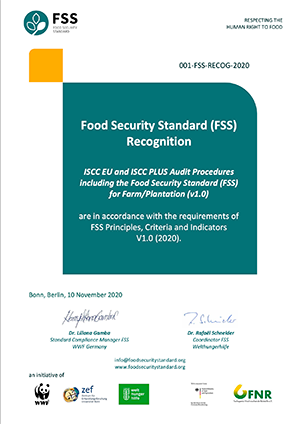
Since November 2020, ISCC EU and PLUS are recognised by the Food Security Standard (FSS). Click here for more information.
The Forum for Sustainable Palm Oil (FONAP) accepts the ISCC certification system for the implementation of its voluntary commitment. FONAP’s purpose is to promote sustainable palm oil production by increasing the use of certified sustainable palm oil in food, feed and chemical products. Click here for more information.
CDP (formerly known as the Carbon Disclosure Project) recognises ISCC as a credible third party certification scheme to demonstrate responsible sourcing practices in areas that are exposed to high risk of deforestation. Click here for more information.